
A Console Action Surprise

Most upright and grand pianos we service on a day to day basis have generally the same action design. When it comes to uprights, they all tend to have a similar design despite the height of the piano. The spinet piano action is different in that it has the drop action, but it’s main components and how they are serviced is still familiar.

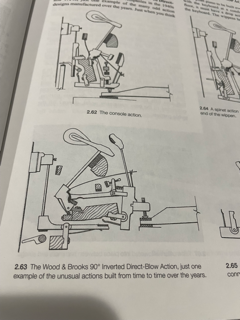
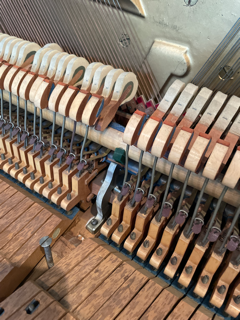
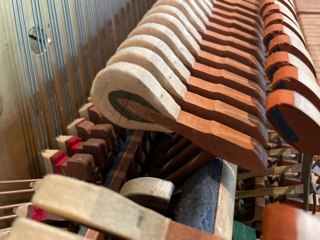
In the 1940’s and 50’s there was an action and keyboard maker called Woods & Brooks that built the 90 degree Inverted Direct-Blow console action. It was just my luck that I came across one of these today. A 1940s Mueller & Haines console with an action mechanism I had never come across before. The jack runs horizontally instead of vertically and the damper levers actually sit below the whippen rail. Some have commented that the design is a hybrid of a grand and upright action. Thankfully I was able to figure out and work with this unusual action and still complete the service for the customer.

My best guess as to why this design was introduced in the first place was to try to develop the most compact action while still being able to have a direct blow action. The size of the piano was similar to a spinet size but was still able to be considered a console. Ultimately spinets ended up taking off a lot more with manufacturers and were predominantly made from the 1940s-80s/90s as the most compact piano by height. I find it fascinating that in our line of work, no matter how much experience and different kind of pianos we have seen before we can still be surprised by some experimental design we haven’t come across before.
Mark Allen, RPT

Registered Piano Technician

Mark is a lifelong musician originally from New Jersey where he was born into a talented family of musicians. His love of music led him to pursue a degree in music at Visible Music College, a small music school in Memphis. Since graduating in 2014, he has played piano and guitar professionally as a performing musician. He has also taught piano and music lessons privately for several educational institutions in Tennessee, Missouri, and Kansas. Mark’s love for piano technology was sparked while working for the Yamaha piano dealer in Memphis where he began learning about piano tuning and maintenance services from the shop technician. Being a pianist, he understood how a finely tuned and maintained instrument should sound and feel.

Piano Technology Education

In 2021, Mark successfully began his professional training, completing a formal piano tuning course. He has continued to develop his craft by attending the Midwest Regional Conference held in Kansas City offered by the Piano Technicians Guild. Mark is a member of the Piano Technicians Guild and will continue to participate in the professional development and training opportunities offer by the organization throughout the year including the National Conventions held each summer. In 2023, he began working with the team at Vanguard Piano Service where he will continue to develop his trade performing field tuning and repairs. Mark completed the rigorous Piano Technician Guild’s certification exams, earning the designation of Registered Piano Technician (RPT) in 2024.

Next
Next

Servicing Pianos in Higher Education: Experiences from the University Setting